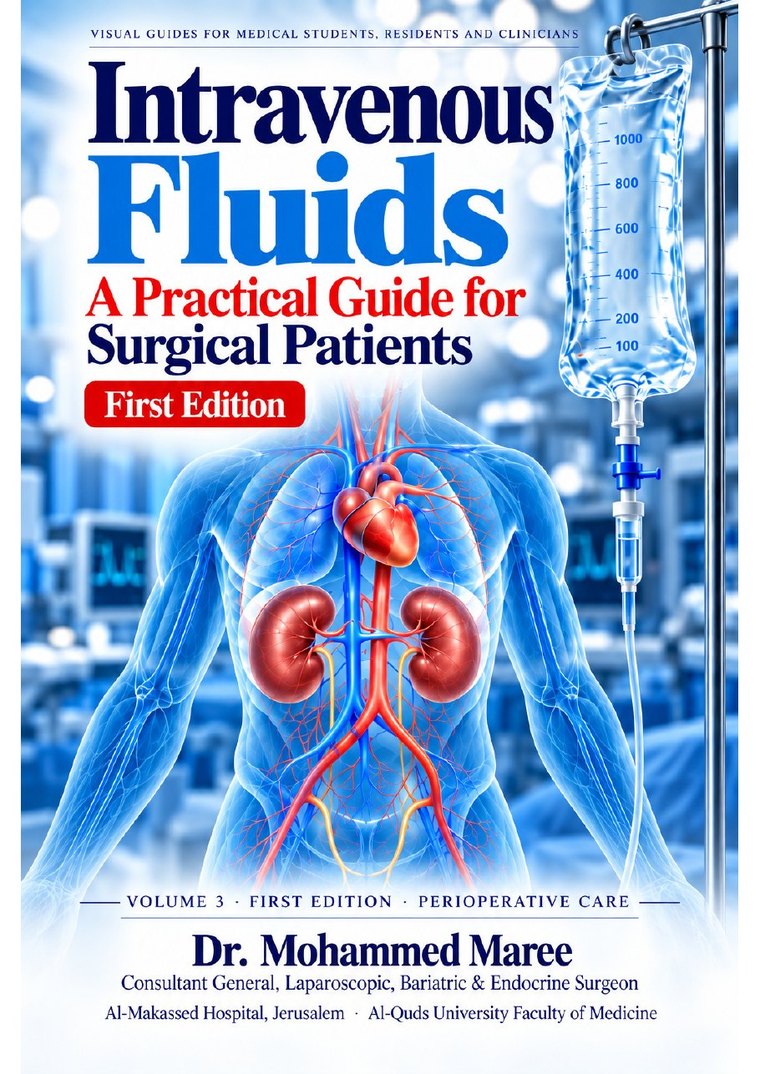
The intravenous fluid chart is often the first prescription a new doctor writes on a surgical ward, and very often it is written at night, quickly, and copied from yesterday’s.
Every bag answers one question: is this fluid for resuscitation, for maintenance, or to replace a loss that is still happening? Get that question right, and the choice of fluid, the volume and the rate follow. This guide takes that question to the surgical patient — the patient who is nil by mouth, the patient with a nasogastric tube and a drain, and the patient whose urine output is falling on the first night after an operation.
DOI: 10.5281/zenodo.23496713 · Licensed CC BY-NC-ND 4.0 · Volume 3 of Visual Guides for Medical Students
The three questions behind every fluid prescription
- Resuscitation — is the circulation short of fluid now? A bolus of balanced crystalloid, then reassess.
- Maintenance — what does this patient need for the next 24 hours if nothing else is lost? Water, sodium, potassium and glucose, matched to the weight.
- Replacement — what is being lost on top of that, from the stomach, the drain, the stoma or the wound, and what does that fluid contain?
What is inside
Three levels, then twelve patients. Start at the level that matches where you are; each one assumes you have finished the one before it. Every chapter is one idea on one page, built around one main figure.
Level 1 · Foundations
- 1.1Why a bag of salty water is a drug
- 1.2Forty-two litres: where body water sits
- 1.3The two walls, and what crosses them
- 1.4Tonicity in plain language
- 1.5One litre, three destinations
- 1.6A normal day: in, out, and balance
- 1.7Is this patient dry? The bedside assessment
- 1.8The practical drip: cannula, set, rate
Ends with a 12-question checkpoint.
Level 3 · The deeper science
- 3.1Osmolality, tonicity and the osmolar gap
- 3.2Starling revisited: the glycocalyx
- 3.3Fluids and acid–base
- 3.4How the kidney defends volume
- 3.5Stress response and volume kinetics
- 3.6Fluid responsiveness
- 3.7The four phases of fluid therapy
- 3.8Sodium: the arithmetic of correction
- 3.9Potassium, magnesium and the rest
- 3.10What the trials actually showed
Level 2 · The fluids themselves
- 2.1The family tree of intravenous fluids
- 2.2Reading a bag like a prescription
- 2.30.9% sodium chloride
- 2.4Hartmann’s and Ringer’s lactate
- 2.5The balanced family
- 2.6Glucose solutions
- 2.7The dextrose–saline maintenance fluids
- 2.8Hypertonic saline and mannitol
- 2.9Colloids I: albumin
- 2.10Colloids II: synthetic agents
- 2.11Blood as fluid
- 2.12Additives
- 2.13Fluids that must never be infused
- 2.14Choosing the bag
Part Two · Twelve patients
Realistic ward scenarios. The left page gives the referral, the observations, the bloods and five questions; stop there and answer them. The right page works through the assessment, the calculation, the model prescription, the common pitfalls and the reassessment.
- The routine post-operative patient
- Small bowel obstruction
- Septic shock
- Haematemesis
- Confusion on day two
- Anuria and a potassium of 6.8
- Diabetic ketoacidosis
- Burns: the first eight hours
- The vomiting child
- Fractured hip with heart failure
- Acute pancreatitis
- Oedematous and still hypotensive
Reference
- Ten rules to take onto the ward
- Formulary: every fluid on one page
- Formulae, reference intervals and answers
A note on units
Electrolytes and lactate are given in mmol/L; urea, creatinine and glucose in mg/dL. The laboratory reference intervals are listed together on page 70 — check them against the laboratory that issued the result before acting on them.
Who it is for
Medical students on their surgical rotation, students preparing for a prescribing or fluid-balance OSCE station, interns writing their first fluid charts, and junior surgical trainees. It assumes no prior knowledge and builds from the physiology to the drug chart.
Practise it on this site
The book has three OSCE stations built around it. Read the chapter, then try the station.
How to cite it
Maree M. Intravenous Fluids: A Practical Guide for Surgical Patients. 1st ed. Visual Guides for Medical Students, Volume 3. Zenodo; 2026. doi:10.5281/zenodo.23496713
Using it in teaching
The licence is CC BY-NC-ND 4.0. You may share and print it for non-commercial teaching, unchanged and with the author credited. Unlike the earlier volumes, this licence does not allow adapted versions. If you use it with a student group, I would be glad to hear how it went.